
 San Diego
· 5 items
City Council, Monday, October 26
On the episode: Council pauses data centers; flat water rate replaces tiers after court loss
This episode was produced with AI from the public recordings of the week's meetings. Links to the sources are in the show notes.
What happened
City Council Monday, October 26
5 items
Closed session: two existing-litigation cases
Lawsuits and settlements
In the morning session the council took public comment on two pending lawsuits against the city, read into the record as CS1 and CS2, then went into closed session. Public commenters described CS1 as a sidewalk trip-and-fall case and CS2 as a suit over a police pursuit that ended in a crash in which two young brothers died. The council's closed-session discussion isn't public, and the city attorney's office reported nothing out at the end of the day. 00:00:48
- Report out from closed session. Result: no action. 02:50:34
Data center moratorium returned to staff, moved to Tuesday Item S401
Data centersZoning and plans
Item S401 is an emergency ordinance that would put a temporary moratorium on developing, establishing, intensifying or expanding data centers citywide, along with a resolution finding the action exempt from state environmental review (CEQA). The agenda says the ordinance needs 8 votes under California Government Code section 65858 and isn't subject to the Mayor's veto. On Monday the item was returned to staff without presentation or deliberation, to be heard Tuesday, October 27, at 10 a.m. as Item S510. Public comment was still taken. 00:17:36
- Item S401 returned to staff, to be heard Tuesday, October 27, as Item S510. Result: continued. 00:17:36
- A councilmember announced that S401 would be heard Tuesday morning under a new item number, S510, and that there would be no presentation or council deliberation on Monday 00:17:36
Fiscal Year 2026 year-end financial performance report Item S400
BudgetsFederal and state funding
An informational report from the Department of Finance on how the city's general fund ended fiscal year 2026 compared with the third-quarter projections. The fund ended $4.7 million short, so the city is drawing $4.7 million from its General Fund Stability Reserve to close the year balanced. The main cause was $7.4 million in state Cal OES reimbursements for the January 2024 storms, now expected in fiscal year 2027. Reserves are expected to fall to $202.4 million, or 10.9% of operating revenues, below the city's 14.1% target. The $1.7 million reserve contribution planned in the FY2027 budget is no longer expected. The Office of the Independent Budget Analyst also presented its analysis. It said this is the first time in recent history the city has drawn on the reserve, and it flagged a sharp drop in the risk management reserves. No vote was taken. 00:21:20
▶ Hear it Is dipping into reserves a wake-up call? · 0:51
- Informational item; no motion required. Result: no action. 01:02:40
- The Department of Finance explained that the report compares unaudited year-end revenues and expenditures with the third-quarter projections 00:22:02
- The Department of Finance reported that the projected available fund balance went from a positive $1.7 million to a negative $4.7 million, requiring a $4.7 million reserve draw 00:23:06
- The Department of Finance explained that much of the rise in both revenues and expenditures came from accounting entries for moving vehicles and equipment to the solid waste management fund, which largely cancel out 00:23:06
- The Department of Finance said property tax revenue fell because of lower collection rates, more refunds from assessment appeals and lower residual RPTTF revenue 00:25:09
- The Department of Finance said sales tax came in above expectations, citing resilient consumer spending and inflation 00:26:20
- The Department of Finance said accounting rules let the city recognize only part of the San Diego Zoo's advance payment in FY2026, with the rest counted in FY2027 00:26:20
- The Department of Finance said later developments cut the projected balance by $18 million, to a $16.3 million shortfall, before mitigation 00:30:31
- The Department of Finance said $11.6 million in mitigation measures and positive developments reduced the shortfall to $4.7 million 00:31:34
- The Department of Finance reported that combined emergency and stability reserves will fall from $207.1 million to $202.4 million, below the 14.1% policy target 00:32:39
- The Department of Finance said no excess equity will be available and the $1.7 million reserve contribution planned in the FY2027 budget is no longer expected 00:32:39
- The Department of Finance said the $7.4 million in Cal OES storm reimbursements once expected in FY2026 is now expected in FY2027 00:33:53
- The Department of Finance reported a same-day update that the city has been approved for $450,000 of the $7.4 million so far 00:33:53
- The Department of Finance said Cal OES reimbursements received in 2027 will first go to replenish the stability reserve 00:34:56
- The Independent Budget Analyst's office said general fund spending ended about $2 million over the adopted budget, or $17.6 million under it without the solid waste asset transfer 00:40:00
- The Independent Budget Analyst's office said fire suppression constant staffing accounted for about $6.3 million, or 78%, of Fire-Rescue's overtime overage 00:40:00
- The Independent Budget Analyst's office said the Transportation department may be relying more heavily on overtime, and recommended closely monitoring overtime trends 00:41:00
- The Independent Budget Analyst's office said police overtime still came in over budget, but much closer to it and well below the last two years' actuals, and that the department's efforts appear to be working 00:41:00
- The Independent Budget Analyst's office noted this is the first time in recent history the city has drawn from the General Fund Reserve 00:42:24
- The Independent Budget Analyst's office said reserve levels will fall from 11.1% to 10.9% of operating revenues, against a 14.1% target 00:42:24
- The Independent Budget Analyst's office reported that the risk management reserves ended almost $50 million under target, or $40 million excluding a loan to the sewer fund 00:43:53
- The Independent Budget Analyst's office recommended that any Cal OES money beyond what the stability reserve needs go to the risk management reserves 00:43:53
- The Independent Budget Analyst's office said the Publishing Services fund's deficit more than doubled, from negative $800,000 to negative $1.7 million 00:44:58
- The Independent Budget Analyst's office said the EMS fund ended $5.3 million below the fund balance the current budget assumed would support the general fund 00:44:58
- The Independent Budget Analyst's office warned that the city has less room for mitigation measures than before, and urged realistic, conservative projections in future budgets 00:45:51
- The Department of Finance said the delayed reimbursements cover city costs for cleanup and recovery after the storms 01:03:11
- The Department of Finance attributed part of the delay to Cal OES's small staff 01:04:41
- A councilmember offered his office's help, including with state legislators, to speed up the reimbursement process, citing possible El Nino effects 01:04:52
- A councilmember noted that the council's budget had set out steps in case the Cal OES money came late, with the reimbursement going first to the stability reserve 01:05:22
- A councilmember cautioned that the years of property tax beating expectations appear to be over, given housing prices and high interest rates 01:05:22
- A councilmember flagged lower parking meter operations revenue as a significant variance to watch 01:06:23
- A councilmember warned that many one-time resources the city has relied on are no longer available for future budgets 01:06:23
- The Department of Finance attributed the property tax dip to slower growth in assessed values, little housing turnover, and more and larger appeals, especially commercial 01:08:27
- The Department of Finance explained that lawsuit settlements are paid from the Public Liability Fund, which the general fund pays into 01:09:35
- A councilmember noted that if the $7.4 million had arrived, the city would have ended about $2.7 million ahead on a roughly $2.2 billion budget 01:10:13
- A councilmember said he would support putting all $7.4 million into reserve accounts when it arrives 01:10:13
- A councilmember noted the balanced budget still carries painful cuts, and encouraged the public to raise budget concerns year-round 01:11:17
New and updated fees to fund the Office of Labor Standards and Enforcement Item 200
Jobs and wagesTaxes and fees
A resolution updating two city fees that pay for enforcing San Diego's minimum wage and labor standards laws. First, the per-employee Minimum Wage Enforcement Fee that employers pay rises from $1.47 to $2.82 per covered employee, effective on approval. It now also covers the Hospitality Minimum Wage Ordinance and funds an added compliance officer. Second, a new one-time Compliance System Usage Fee, charged to prime contractors on city contracts, runs from $144.35 to $4,853.24 per contract across eight tiers based on contract value, effective January 1, 2027. Staff projected about $1.8 million a year in cost recovery once fully implemented. A third fee, for traffic control worker minimum wage enforcement, was deferred for more legal review. The council approved the resolution 7-0. 01:11:57
▶ Hear it Can the city fine employers who underpay workers? · 0:58
- Henry Foster (Councilmember, District 4) moved the staff recommendation, with staff's commitment to report on the fees in its annual reports; Sean Elo-Rivera (Councilmember, District 9) seconded. Result: passed, 7-0. 01:43:19Ayes: Joe LaCava, Jennifer Campbell, Henry Foster, Kent Lee, Raul Campillo, Vivian Moreno, Sean Elo-Rivera. Absent: Stephen Whitburn, Marni von Wilpert. Moved by Henry Foster, seconded by Sean Elo-Rivera. From the clerk's record
- The Office of Labor Standards and Enforcement presented the request to approve two cost-recovery fees for the city's labor standards programs 01:12:33
- The Office of Labor Standards and Enforcement said the two fees together are projected to recover about $1.8 million a year once fully implemented 01:13:39
- The Office of Labor Standards and Enforcement said a third fee for traffic control worker minimum wage enforcement was deferred for more legal review of possible exemptions 01:14:45
- The Office of Labor Standards and Enforcement said the office's duties grew with new ordinances but its staffing didn't 01:15:54
- The Office of Labor Standards and Enforcement said the minimum wage enforcement fee would rise from $1.47 to $2.82 per covered employee 01:16:58
- The Office of Labor Standards and Enforcement said about $1.5 million in annual program costs was divided by the estimated number of covered employees to set the fee 01:18:02
- The Office of Labor Standards and Enforcement said the compliance system fee would be charged to the prime contractor on a covered city contract 01:20:20
- The Office of Labor Standards and Enforcement described an eight-tier compliance system fee that rises with contract value and is charged once per contract, not annually 01:22:26
- The Office of Labor Standards and Enforcement gave the tier range as starting at $144.35 and rising to $4,853.24 for the largest contracts 01:22:26
- The Office of Labor Standards and Enforcement said outreach included notices sent to about 27,000 city vendors and contractors, plus direct contact with hotels and motels 01:23:37
- The Office of Labor Standards and Enforcement said the minimum wage fee would take effect on council approval and the compliance system fee on January 1, 2027 01:24:38
- A councilmember asked whether the council already gets annual reports on compliance efforts, so fee information could go in them, as the lodging association had requested 01:32:49
- The Office of Labor Standards and Enforcement agreed to include information about the fees in the office's existing annual reports 01:33:48
- The Office of Labor Standards and Enforcement named restaurants, hotels and motels, janitorial and construction as the industries with the most violations 01:35:10
- The Office of Labor Standards and Enforcement said the added compliance officer would allow proactive investigations that don't wait for complaints 01:35:42
- A councilmember said workers in those industries are vulnerable and often hold several jobs, and backed giving the office more resources 01:36:22
- A councilmember said he has long wanted new legislation paired with the capacity to enforce it 01:36:50
- A councilmember asked for a one-time first-year review of whether the fees are true cost recovery and whether they improve compliance 01:37:53
- A councilmember asked whether the city can impose penalties on minimum wage violators, beyond recovering back wages 01:39:30
- The Office of Labor Standards and Enforcement said the city has collected about $100,000 in penalties over the past ten years 01:40:01
- The Office of Labor Standards and Enforcement said the office often waives penalties in settlements to get small businesses to pay workers their back wages 01:40:13
- A councilmember argued that bad actors should pay more and compliant businesses less 01:40:51
- A councilmember urged the city to seek bigger penalties, rather than settle, where there is evidence of intentional underpayment 01:41:55
First step to overrule airport commission on child care centers near MCAS Miramar Item 201
Zoning and plansChildren and familiesAirports and aviation
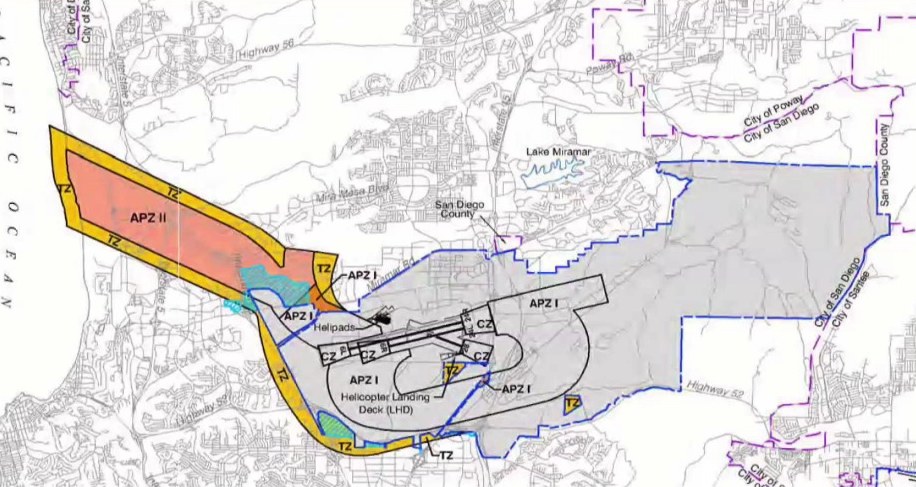
The council voted to propose overruling the San Diego Airport Land Use Commission. On July 9 the commission found Item 93 of the city's 2026 Land Development Code update inconsistent with the MCAS Miramar airport land use compatibility plan. Item 93 would allow new child care centers as a limited use, capped at a 0.42 floor area ratio, in the Miramar 'transition zone', where new centers are now prohibited. Existing centers there may already expand or rebuild up to 300 people per acre, and staff said the cap matches that limit. State law requires a two-thirds vote at two separate public hearings to overrule the commission; the agenda says 6 votes were required. Next, the Planning Commission makes a recommendation, and a second full council hearing comes at least 45 days after this one. The agenda lists Districts 1 and 6 as affected, and staff named community planning areas including Torrey Pines, University, Mira Mesa, Clairemont and Kearny Mesa. The motion passed 6-0 with three members absent. 01:43:45
- Kent Lee (Councilmember, District 6; President Pro Tem, City Council) moved the staff recommendation: adopt a resolution proposing to overrule the Airport Land Use Commission's inconsistency determination for Item 93, send notice to the commission, Caltrans and the U.S. Marine Corps, and schedule the item at the Planning Commission; Sean Elo-Rivera (Councilmember, District 9) seconded. Result: passed, 6-0. 02:09:51Ayes: Joe LaCava, Jennifer Campbell, Henry Foster, Kent Lee, Raul Campillo, Sean Elo-Rivera. Absent: Stephen Whitburn, Marni von Wilpert, Vivian Moreno. Moved by Kent Lee, seconded by Sean Elo-Rivera. From the clerk's record
- The City Planning Department explained that the amendment would allow child care centers as a limited use with a 0.42 floor area ratio in the Miramar transition zone 01:44:43
- The City Planning Department noted that child care centers are currently prohibited in the transition zone 01:45:47
- The City Planning Department said the floor area cap for new centers matches the 300-people-per-acre limit already allowed for expanding existing centers 01:46:48
- The City Planning Department said the Airport Land Use Commission found Item 93 inconsistent at a July 9 hearing and found the rest of the code update consistent 01:47:49
- The City Planning Department said state law lets the council overrule the commission with a two-thirds vote at two separate public hearings 01:48:52
- The City Planning Department said neither the Miramar compatible use zone study nor the state handbook recommends a transition zone, which the commission added as an extra buffer 01:49:54
- The City Planning Department said centers would still have to meet existing airport noise rules, including a 45-decibel indoor level 01:51:55
- The City Planning Department said the item next needs a Planning Commission recommendation by November 01:53:59
- The City Planning Department reported that the Community Planners Committee opposed Item 93 in February 01:55:02
- The City Planning Department said the committee wanted centers in the zone to need a site development permit instead of a ministerial permit, because they would be close to the accident potential zone 01:55:02
- A councilmember said he had supported Item 93 as part of the 2026 Land Development Code package 02:02:28
- A councilmember distinguished the accident potential zones from the transition zone, which neither Miramar nor the state handbook recommends 02:02:28
- A councilmember cited the high cost of child care and the value of locating it near the employment centers in Sorrento Valley and Miramar 02:03:30
- A councilmember moved the staff recommendation to start the overrule process 02:04:34
- A councilmember said his office consulted a regional child care advocate, who supported the change 02:05:41
- A councilmember argued that more child care near people's jobs matters, citing the extra hour his family sometimes spends driving to child care 02:05:41
- A councilmember said most of the public comment on the item was wrong and stressed that the item is only a zoning matter 02:07:03
- A councilmember said he had voted against Item 93 earlier, partly out of frustration over an unrelated council decision about Little Italy 02:08:08
- A councilmember called the change a technical fix that makes new centers consistent with existing ones, rather than a policy shift, and staff agreed 02:08:08
Public comment
- Closed session (CS1, CS2): six speakers. On the sidewalk trip-and-fall case, several argued that settlements drain money that could repair sidewalks. On the police pursuit case, speakers offered condolences for the two young brothers who died, urged a quick settlement (one noted it has been three years), questioned the city's pursuit policy, and suggested naming a stretch of freeway in the boys' memory. One speaker criticized councilmembers on the Public Safety Committee and the city's Flock surveillance contract.
- Item S401 (data center moratorium): three speakers, all supportive or neutral. One noted that federal action could still bring data centers, such as at NAVWAR, and one would have preferred the item be heard Monday.
- Item S400 (year-end financial report): about 13 speakers. Several questioned homelessness spending and the lack of performance metrics, and one asked that unspent homelessness money go to improving conditions at a city encampment. Others raised the cost of surveillance technology and lawsuit settlements, whether commercial properties are properly assessed (with a concern about the Midway Rising financing district), unmonitored city leases, out-of-town contracting, and the reserve draw as a warning sign. One praised the city's focus on fiscal stability, and one made allegations about the mayor's legal fees and a city-funded nonprofit.
- Item 200 (labor standards fees): eight speakers. The San Diego County Lodging Association supported the fees and asked for a report back within a year on how the money is used, and two other in-person speakers supported the item. One asked whether undocumented workers would be covered, one asked about protecting workers' right to unionize, and one caller opposed nearly doubling the fee during a budget crunch and questioned the Oakland comparison. The rest were off-topic or general.
- Item 201 (child care near MCAS Miramar): five speakers. Two in-person speakers opposed it, one raising child abuse and trafficking fears and one saying they wanted more information. Callers asked where the item fits among budget priorities while supporting child care needs, lamented the need for child care, and suggested putting centers outside flight areas.
- Non-agenda public comment: about 17 speakers. Three marked Red Ribbon Week and urged youth drug and marijuana prevention, and two or three criticized Flock cameras and police spending. Single speakers raised: blighted buildings in District 3, accountability for a police shooting, vacancies on the city's Human Relations Commission, delays in replacement ID cards from the DMV, the workload in Economic Development and Cultural Affairs, the city clerk's rules for submitting media, out-of-county contracting and settlements, alcohol license concentration and a proposed nightlife office, data centers and the Tijuana River, and general distrust of government. One caller made disparaging remarks about Muslim immigrants.
What's next
- The data center moratorium (S401) was scheduled to be heard Tuesday, October 27, at 10 a.m. as Item S510; the agenda said the emergency ordinance needed 8 votes.
- The council adjourned to its regular meeting on Tuesday, October 27, 2026, at 10 a.m.
- Department of Finance: an update on the Cal OES storm reimbursements will come in the FY2027 first-quarter budget monitoring report, and the FY2028-2032 five-year financial outlook is due in November.
- Proposed updates to the city's reserve policy are expected to be presented later this year, per finance staff.
- Cal OES reimbursements received in FY2027 are to go first to replenishing the $4.7 million stability reserve draw.
- Labor standards fees: the compliance system usage fee takes effect January 1, 2027. Staff agreed to report fee information in its annual reports, plus a one-time first-year review of cost recovery and effectiveness requested by Joe LaCava (Councilmember, District 1; President, City Council). The deferred traffic control worker fee is to come back separately.
- Item 201: notice of the proposed overrule goes to the Airport Land Use Commission, Caltrans and the U.S. Marine Corps. The Planning Commission is to make a recommendation (by November, per staff), then a second full council hearing at least 45 days after this one, again needing a two-thirds vote.
- Agenda public notice: the 'Cielo Mar' final map at 7303 La Jolla Shores Drive can be appealed within 10 calendar days of this meeting.
Write to the City Council before its next meeting: its comment form